The Jurisprudence of Bail: Reasoned Orders and Judicial Discretion

In India, the jurisprudence of bail is undergoing a significant transformation. From being an arbitrary exercise to a structured judicial process, the Supreme Court has consistently emphasized that bail decisions must reflect sound reasoning and judicial mindfulness. The shift is not just procedural but reflects a deeper concern for upholding personal liberty, constitutional values, and the integrity of the justice system.

Below is a synthesis of landmark rulings that have laid down the contours of how courts must approach bail—particularly in ensuring that orders are reasoned, not cryptic, and compliant with the principles of natural justice.

1. Y. v. State of Rajasthan, (2022) 9 SCC 269

The Supreme Court criticized the High Court’s cryptic bail order, observing that such judgments do not reflect judicial application of mind. The Court lamented the growing trend of vague bail orders merely stating that “facts and circumstances have been considered” without spelling out what those facts are.

Key Takeaway:

A judicial order bereft of reasons is not just inadequate—it is arbitrary. “Reasoning is the lifeblood of the judicial system,” and vague references like “having perused the record” do not suffice.

2. Deepak Yadav v. State of U.P., AIR 2022 SC 2514

Here, the apex court reiterated that sound reasoning is essential, especially when serious offences are involved. The decision-maker must reassure the parties that discretion has been exercised judicially, after examining relevant considerations and ignoring extraneous ones.

3. Manoj Kumar Khokhar v. State of Rajasthan, (2022) 3 SCC 501

In this case, the Court invoked the Latin maxim: “cessante ratione legis cessat ipsa lex” — meaning, when the reason for a law ceases, so does the law itself. It held that cryptic and casual bail orders without meaningful justification are liable to be set aside.

4. Jaibunisha v. Meharban, (2022) 5 SCC 465

The Court clarified that although elaborate reasoning may not be required at the bail stage, some reasoning is indispensable. An order that lacks even basic rationale cannot be sustained.

5. Brijmani Devi v. Pappu Kumar, (2022) 4 SCC 497

Reiterating the need for relevant reasoning, the bench held that granting cryptic bail amounts to violation of natural justice. A “non-speaking order” renders the prosecution or informant remediless, justifying a challenge before a higher forum.

6. Ishwarji Nagaji Mali v. State of Gujarat, (2022) 6 SCC 609

The judgment acknowledges that while a detailed examination of evidence may not be possible at the bail stage, prima facie reasons justifying the grant of bail must be indicated. Absence of such reasoning renders the order unsustainable.

7. Sonu v. Sonu Yadav and Ors., (2021) 15 SCC 228

The Court explained how judicially reasoned bail orders bring transparency and credibility to the criminal justice process. Reasoned orders act as a bridge between judicial discretion and public trust.

8. Arnesh Kumar v. State of Bihar, (2014) 8 SCC 273

This judgment laid the foundation for limiting unnecessary arrests, especially in offences punishable with imprisonment up to 7 years. The Court directed police officers not to arrest automatically and required magistrates to apply judicial mind before authorizing detention.

Significance for Bail Jurisprudence:

It curbed mechanical arrests and called for recording reasons for both arrest and remand. Bail became the rule, not the exception.

9. Satender Kumar Antil v. CBI, (2022) 10 SCC 51

A pathbreaking judgment that introduced structured bail guidelines, the Court classified offences into categories and directed strict compliance with arrest and bail norms. It reinforced that:

  • For Category A offences (punishable up to 7 years), arrest should be avoided.
  • Default bail must be respected under Section 167(2) CrPC.
  • Courts must not delay bail on technicalities or minor lapses.

Conclusion

The Supreme Court’s consistent refrain is that bail is not to be denied merely as a punitive measure, nor granted casually without rational basis. Courts must strike a delicate balance between individual liberty and societal interest by:

  • Recording cogent reasons;
  • Avoiding non-speaking, vague, or template-like orders;
  • Exercising discretion free from arbitrariness.

The evolving jurisprudence makes it clear: bail orders must speak. And when they do, they echo the Constitution’s promise of fairness, liberty, and reason.

Adv. Jayendra Dubey
advdubeyjayendra@gmail.com 
Available At: 
Chamber Number 222/6, District Court Compound, Surajpur, Greater Noida, Gautam Buddha Nagar 201306 
Also At: IJLS & Partners, P3-362, Paramount Golfmart, Surajpur, Greater Noida, Gautam Buddha Nagar 201306
Accountability Vs Overreach

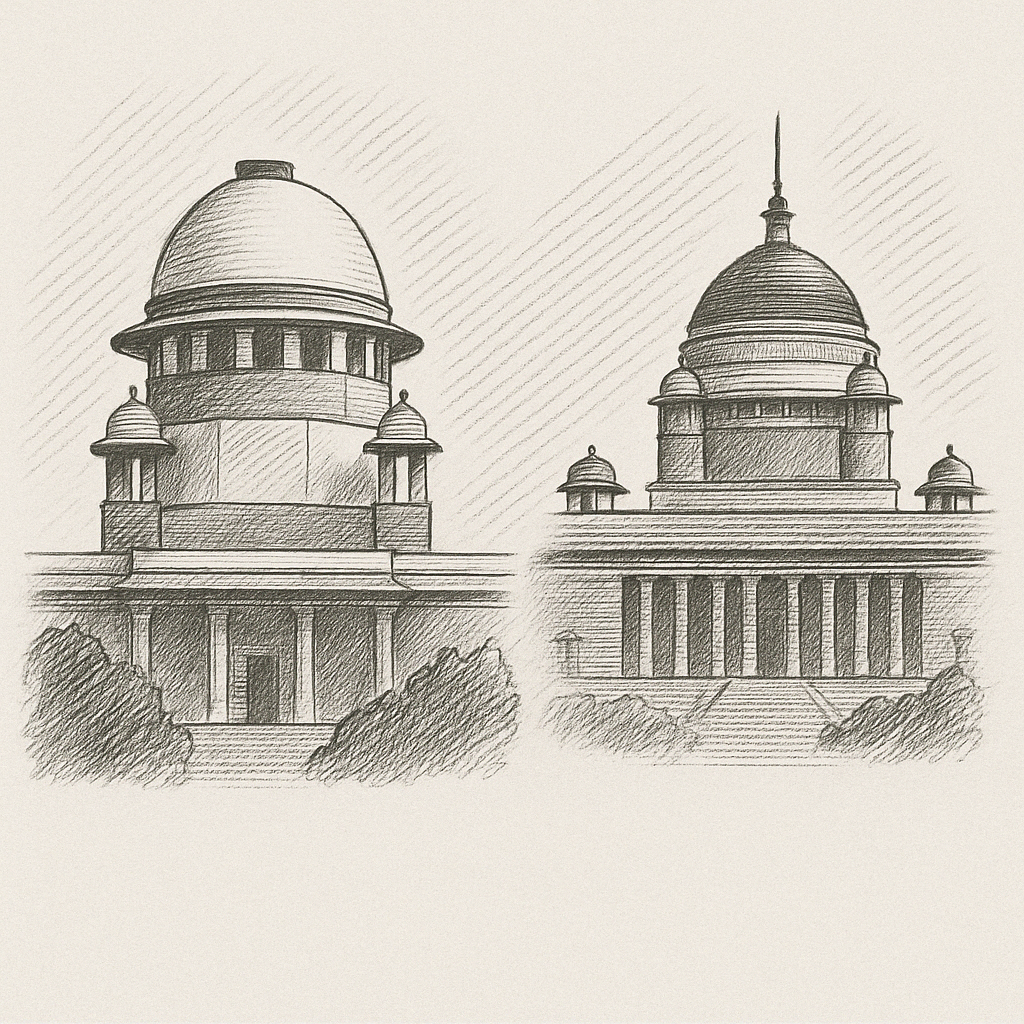
Once upon a quiet morning in Delhi – just yesterday – a constitutional clock began ticking—not on the walls of North Block, not in the Parliament’s echoing halls—but from the Courtroom Number One of the Supreme Court of India. The justices weren’t merely interpreting law that day; they were asking a question that shook the silence of Raisina Hill:

“Can the President of India keep a Bill waiting forever?”

That one question has now turned into a national debate—on federalism, legislative sanctity, and what critics call judicial overreach. But is it really overreach, or is it just the judiciary doing what it must when others don’t?

The Trigger: A Delayed Assent and a Waiting State

At the heart of it lies a chain of bills—some from non-BJP-ruled states—that were passed by state legislatures, sent to governors, and from there, made their way into the silent corridors of Rashtrapati Bhavan, only to sit without response. One of them was a Tamil Nadu bill on NEET exemption, others followed from Telangana, Kerala, and Punjab.

Months passed. Even years. No assent. No rejection. Just silence.

In constitutional language, this isn’t just a delay. It’s a denial of democracy, where elected representatives are told, without being told, that their laws don’t matter.

Enter the Supreme Court: A Gentle Reminder with a Firm Hand

In April 2025, the Supreme Court took a firm stance. It directed that the President of India must act on bills referred to her within a “reasonable time”—not exceeding three months.

It was not a command to pass a bill. It was not a push to reject it either. It was merely a constitutional alarm clock—saying “You must act. Democracy cannot wait indefinitely.”

The Backlash: Overreach or Oversight?

Vice President Jagdeep Dhankhar soon issued a sharp response. “The judiciary is turning into a super-parliament,” he warned. “Can courts now direct the President of India?”

This criticism echoes a concern many have raised in recent years: Is the judiciary crossing lines? Is it stepping into the shoes of the executive or legislature?

But Here’s the Counterpoint: Constitutional Silence Must Be Filled, Not Exploited

Let us be clear. The Supreme Court did not issue this direction under whim. It exercised its jurisdiction under Article 142—to do complete justice. And what could be more just than ensuring a legislative process reaches its logical end?

The Constitution never imagined that a Governor or the President could sit on a bill indefinitely. Our founding fathers didn’t envision executive silence as a political tool. And when constitutional gaps are weaponized into paralysis, judicial intervention is not overreach—it is oversight.

The Real Issue: Constitutional Morality and Federal Fairness

This case isn’t just about timelines. It’s about:

  • Federalism: When State Governments are unable to enforce laws passed by their legislatures, what message does it send about India’s unity in diversity?
  • Legislative Respect: Laws passed by elected assemblies deserve an answer—yes, no, or return with objections—not eternal limbo.
  • Institutional Responsibility: The President, bound by the advice of the Union Cabinet under Article 74, cannot be made a political shield.

What About Separation of Powers?

The separation of powers doctrine, often quoted in such debates, does not mean isolation. It means each organ must act within its role, and when one fails, another must intervene to preserve constitutional balance.

Think of it like a relay race. If the runner holding the baton stops mid-track, someone must nudge him—not to take the baton, but to remind him to keep moving.

In Closing: The Constitution is Not a Museum

It’s a living document. And sometimes, when the pens of legislators are paused and the signatures of executives are stalled, it is the gavel of the judiciary that must gently knock on the gates of democracy.

“Silence in governance is not neutrality. It is a choice. And when that silence stifles democracy, the courts are not only allowed—but obliged—to act.”

So no, this was not judicial overreach. It was constitutional stewardship. And the bell that rang from the Supreme Court was not a rebellion—it was a reminder that time, law, and democracy must all keep moving forward.

Supreme Court Ruling on FIRs: A New Era

“Ae khoon ke pyase, baat suno…”

When Rajya Sabha MP Imran Pratapgarhi posted these poetic lines on Instagram—lines echoing dissent and anguish—the Gujarat police responded by registering an FIR against him, citing provisions under the Indian Penal Code. But what followed wasn’t just a legal tussle over a social media post. It sparked a profound judicial reflection on how our criminal justice system must evolve in the age of voices and verses.

The Supreme Court of India recently delivered a landmark judgment that not only quashed the FIR but also took the opportunity to dissect the core procedural shifts introduced by the newly minted Bharatiya Nagarik Suraksha Sanhita, 2023 (BNSS)—India’s replacement for the long-standing Code of Criminal Procedure, 1973 (CrPC).

The Old Order: CrPC and FIRs Without Pause

For decades, the rule was clear. Under Section 154 of the CrPC, if you walked into a police station and reported a cognizable offence, the police had no choice—they had to register an FIR. No second-guessing. No inquiry. Even if the complaint sounded outrageous, if it disclosed a cognizable offence, it had to be recorded.

This was reaffirmed in the famous Lalita Kumari case, where the Supreme Court clarified that a preliminary inquiry was not permissible unless the information failed to disclose a clear cognizable offence.

And while that ensured accountability and swift action, it also left space for frivolous or politically motivated complaints to enter the criminal justice pipeline, sometimes chilling free speech and honest dissent in the process.

Enter BNSS: A Law That Hears Before It Strikes

The BNSS seeks to address this imbalance, and in doing so, makes a “significant departure” from its predecessor.

In the recent judgment, the Supreme Court—through a bench comprising Justice Abhay Oka and Justice Ujjal Bhuyan—zeroed in on Section 173 of the BNSS, the counterpart of Section 154 CrPC. At first glance, the two look nearly identical. But the twist lies in sub-section (3) of the new provision.

Under Section 173(3) of BNSS, when an officer receives information about a cognizable offence punishable by 3 to less than 7 years of imprisonment, they can pause, seek permission from a superior officer, and conduct a preliminary inquiry—just to see whether there’s actually a prima facie case.

In other words, before the ink hits the FIR register, the officer has a window to filter out the noise from real offence.

Why This Matters: A Poet’s Case in Point

In Pratapgarhi’s case, the poem’s words were powerful, perhaps unsettling to some. But the Supreme Court emphasized that freedom of speech, especially political and poetic expression, is constitutionally protected.

Registering an FIR over such expression, without the due caution BNSS now allows, could result in misuse of process. And that’s precisely what the new law aims to prevent.

The Court explained: Just because words are spoken or written, doesn’t mean they amount to a criminal offence. A police officer must first read, understand, and apply legal reasoning. That act—of merely interpreting content—isn’t a “preliminary inquiry” barred under Section 173(1), the Court clarified. But under Section 173(3), if the offence falls within that 3-7 year range, an actual preliminary inquiry can and should be conducted before registering an FIR.

A Legal Tightrope: Speed vs. Scrutiny

The judiciary acknowledged the tightrope walk here. Too much discretion, and justice may be delayed or denied. Too little, and we risk weaponizing criminal law against dissenters, journalists, poets, and activists.

With Section 173(3), BNSS introduces a calibrated discretion. Not a license to avoid registering FIRs, but a tool to screen allegations with lower gravity—provided the officer gets a green light from a senior.

It’s a subtle but powerful change. One that says: “Let the law listen before it acts.”

A New Chapter in Criminal Justice

This judgment is not just about a poem or a politician. It’s about how the law treats the first whisper of an allegation. It’s about building a system that is as sensitive to constitutional freedoms as it is to criminal violations.

So as BNSS begins to shape the new face of procedural law in India, the message from the top court is clear: In a democracy, FIRs are not just legal documents—they are instruments of power. And power must be exercised with reason, not reflex.

Adv. Jayendra Dubey
advdubeyjayendra@gmail.com
Available At:
Chamber Number 222/6, District Court Compound, Surajpur, Greater Noida, Gautam Buddha Nagar 201306
Also At: IJLS & Partners, P3-362, Paramount Golfmart, Surajpur, Greater Noida, Gautam Buddha Nagar 201306

Matrimonial Disputes: A Legal Battlefield or a Tool for Vendetta?

In the courtroom corridors where justice is sought, matrimonial disputes stand out as a uniquely complex category of cases. They are emotionally charged, legally intricate, and socially impactful. Having practiced law for several years, I have observed a troubling trend—marital litigation is increasingly being weaponized as a tool for vendetta rather than a quest for justice.

India’s legal framework for matrimonial disputes, particularly laws like Section 498A of the Indian Penal Code (IPC)/ Section 84 of Bhartiya Nyay Sanhita 2023 and the Protection of Women from Domestic Violence Act, 2005, was designed to protect women from harassment, abuse, and violence. These provisions have, without a doubt, provided much-needed relief to countless women in distress. However, their misuse has created an alarming counter-narrative—one where these laws are being wielded as weapons of retribution rather than shields for protection.

Litigation: A Path to Settlement or Extortion?

The primary purpose of the judiciary in matrimonial disputes should be to resolve issues, ensure justice, and facilitate amicable settlements wherever possible. However, the reality often unfolds differently. Many cases drag on for years, burdening both parties emotionally and financially. The prolonged litigation process frequently becomes less about justice and more about targeting a “sweet number”—a financial settlement that one party can extract from the other.

Take the case of Rajesh Kumar & Others vs. State of Uttar Pradesh (2017), where the Supreme Court acknowledged the misuse of Section 498A as a tool to harass and coerce the accused. The Court observed that false complaints under this provision often result in prolonged litigation, forcing families to concede to unreasonable settlements simply to end the ordeal. The decision introduced guidelines for Family Welfare Committees to scrutinize allegations before legal action is initiated—an important step, though implementation remains inconsistent.

Similarly, in Preeti Gupta vs. State of Jharkhand (2010), the Supreme Court noted that the involvement of the groom’s extended family, often including elderly parents and siblings living far away, highlights the malicious intent behind many complaints. The misuse of these provisions not only clogs the judiciary with frivolous cases but also detracts from the focus on genuine instances of harassment.

A System Tilted Too Far?

There is no denying that our matrimonial laws are heavily inclined in favor of women. This bias, while well-intentioned, creates a legal imbalance. It often leaves the groom and his family defenseless against false accusations, with limited recourse for proving their innocence. The social stigma associated with such cases exacerbates their plight, even when allegations are baseless.

The story of Amit (name changed for anonymity), a software engineer, is a poignant example. His wife filed multiple cases against him and his family, including allegations of domestic violence and dowry harassment, after a dispute over financial contributions to household expenses. Despite providing evidence of his wife’s extravagant spending and the absence of dowry demands, Amit’s family endured years of litigation. Eventually, the case was dismissed as frivolous, but not before irreparably damaging familial relationships and careers.

At the same time, it is essential to recognize that the original intent behind these laws remains valid. Women in India, particularly in rural and patriarchal settings, continue to face systemic oppression and violence. These laws were—and still are—necessary to protect those who lack the resources or societal support to defend themselves. However, the pendulum has swung too far, necessitating a recalibration to ensure fairness and equity.

The Need for Judicial Prudence and Reform

The misuse of matrimonial laws underscores the urgent need for judicial prudence. Courts must distinguish between genuine grievances and malicious litigations. Mechanisms such as pre-litigation mediation and stricter penalties for filing frivolous cases can serve as deterrents against misuse.

For instance, courts should emphasize mediation before the registration of an FIR in matrimonial disputes. The Arnesh Kumar vs. State of Bihar (2014) judgment directed that arrests in dowry cases should not be made automatically and without proper investigation. Implementing this directive more rigorously could prevent unnecessary arrests and harassment.

Furthermore, reforms should aim for gender-neutrality in laws governing harassment and domestic violence. Men, too, can be victims of emotional and physical abuse, though such cases often go unreported due to societal stigma. Expanding the scope of these laws to address abuse holistically could create a more balanced legal framework.

A Call for Societal Change

Beyond legal reforms, there is a pressing need for societal change. Matrimonial disputes often arise from deeply ingrained cultural expectations and rigid gender roles. Education and awareness campaigns can play a crucial role in fostering healthier relationships and reducing conflicts. Families must also play a more constructive role, prioritizing resolution over retaliation.

The concept of marriage itself must be reframed—from a transaction between families to a partnership between individuals. Mutual respect and communication should be emphasized, while societal pressures to conform to outdated norms should be challenged.

Conclusion

Matrimonial laws were never meant to be weapons of vendetta; they were tools of justice and protection. It is imperative for lawmakers, the judiciary, and society at large to address the growing misuse of these laws while ensuring their original purpose is not diluted.

A legal system that is fair and impartial is the cornerstone of any civilized society. As we move forward, the goal should not merely be to win cases but to heal relationships and provide justice in its truest sense. Only then can matrimonial disputes evolve from battlegrounds into pathways for reconciliation and closure.

Adv. Jayendra Dubey

A Comparative Analysis: Section 156 of CrPC, 1973, and Section 175 of BNSS, 2023

In the evolving landscape of Indian legal procedures, the introduction of the Bharatiya Nagarik Suraksha Sanhita (BNSS), 2023, marks a significant milestone. This new legislation brings forth modernized practices aimed at enhancing the efficiency and accountability of the criminal justice system. A critical comparison between Section 156 of the Code of Criminal Procedure (CrPC), 1973, and Section 175 of BNSS, 2023, sheds light on the progressive changes introduced by the latter.

Section 156 of CrPC, 1973: Empowering the Police

Provision Overview:

  • Subsection (1): Empowers any officer in charge of a police station to investigate any cognizable case without needing prior approval from a Magistrate.
  • Subsection (2): Allows police officers to investigate offenses even if they were committed outside their territorial jurisdiction.
  • Subsection (3): Enables a Magistrate to order an investigation into any case, ensuring oversight in instances where the police may not act.

Key Takeaways:

  • Scope and Authority: Section 156 grants wide-ranging powers to police officers, facilitating prompt action in cognizable cases without the need for immediate judicial oversight.
  • Jurisdictional Flexibility: Officers can investigate offenses outside their jurisdiction, ensuring that legal boundaries do not hinder the pursuit of justice.
  • Magistrate’s Oversight: The provision for Magistrate-directed investigations acts as a safeguard against police inaction, allowing citizens to seek judicial intervention.

Section 175 of BNSS, 2023: Modernizing Investigations

Provision Overview:

  • Digitalization and Modernization: Advocates for the use of digital tools and modern investigative techniques to improve efficiency and accuracy.
  • Stricter Timelines: Introduces deadlines for completing investigations to ensure timely justice.
  • Enhanced Accountability: Implements stronger oversight mechanisms to reduce instances of police misconduct or negligence.

Key Takeaways:

  • Technological Integration: By incorporating digital tools, BNSS aims to streamline investigations, ensuring better evidence preservation and quicker case resolutions.
  • Timelines: Stricter timelines prevent unnecessary delays, promoting a more efficient justice system. However, it is essential to monitor the practicality of these deadlines to avoid rushed or incomplete investigations.
  • Accountability: Enhanced oversight mechanisms, such as regular audits and penalties for non-compliance, aim to ensure that police officers adhere to ethical standards and procedural requirements.

Comparative Analysis

  1. Empowerment vs. Oversight:
  • CrPC Section 156: Primarily focuses on empowering police officers with broad investigative powers.
  • BNSS Section 175: Balances empowerment with enhanced oversight and accountability, preventing misuse of power and ensuring thorough investigations.
  1. Technological Integration:
  • CrPC Section 156: Traditional in its approach, with less emphasis on modern tools.
  • BNSS Section 175: Embraces digital tools and modern techniques, representing a progressive shift towards a more efficient investigation process.
  1. Timelines and Efficiency:
  • CrPC Section 156: Does not specify strict timelines for investigations.
  • BNSS Section 175: Enforces strict timelines to expedite investigations, though the implementation and adherence to these timelines need careful assessment.
  1. Jurisdictional Flexibility:
  • Both sections offer flexibility in jurisdiction, but BNSS includes more structured procedures to maintain uniformity.

Conclusion

Section 156 of CrPC has been a cornerstone in empowering police officers to investigate cognizable offenses swiftly. However, its lack of emphasis on modern investigative tools and accountability has occasionally led to inefficiencies and misuse of power.

On the other hand, Section 175 of BNSS addresses these gaps by integrating digital tools, imposing stricter timelines, and enhancing oversight mechanisms. These changes aim to make the investigation process more efficient, transparent, and accountable.

The success of BNSS in revolutionizing the investigative process will hinge on its effective implementation and the ability to navigate the practical challenges that may arise.

Adv. Jayendra Dubey

advdubeyjayendra@gmail.com