The Jurisprudence of Bail: Reasoned Orders and Judicial Discretion

In India, the jurisprudence of bail is undergoing a significant transformation. From being an arbitrary exercise to a structured judicial process, the Supreme Court has consistently emphasized that bail decisions must reflect sound reasoning and judicial mindfulness. The shift is not just procedural but reflects a deeper concern for upholding personal liberty, constitutional values, and the integrity of the justice system.

Below is a synthesis of landmark rulings that have laid down the contours of how courts must approach bail—particularly in ensuring that orders are reasoned, not cryptic, and compliant with the principles of natural justice.

1. Y. v. State of Rajasthan, (2022) 9 SCC 269

The Supreme Court criticized the High Court’s cryptic bail order, observing that such judgments do not reflect judicial application of mind. The Court lamented the growing trend of vague bail orders merely stating that “facts and circumstances have been considered” without spelling out what those facts are.

Key Takeaway:

A judicial order bereft of reasons is not just inadequate—it is arbitrary. “Reasoning is the lifeblood of the judicial system,” and vague references like “having perused the record” do not suffice.

2. Deepak Yadav v. State of U.P., AIR 2022 SC 2514

Here, the apex court reiterated that sound reasoning is essential, especially when serious offences are involved. The decision-maker must reassure the parties that discretion has been exercised judicially, after examining relevant considerations and ignoring extraneous ones.

3. Manoj Kumar Khokhar v. State of Rajasthan, (2022) 3 SCC 501

In this case, the Court invoked the Latin maxim: “cessante ratione legis cessat ipsa lex” — meaning, when the reason for a law ceases, so does the law itself. It held that cryptic and casual bail orders without meaningful justification are liable to be set aside.

4. Jaibunisha v. Meharban, (2022) 5 SCC 465

The Court clarified that although elaborate reasoning may not be required at the bail stage, some reasoning is indispensable. An order that lacks even basic rationale cannot be sustained.

5. Brijmani Devi v. Pappu Kumar, (2022) 4 SCC 497

Reiterating the need for relevant reasoning, the bench held that granting cryptic bail amounts to violation of natural justice. A “non-speaking order” renders the prosecution or informant remediless, justifying a challenge before a higher forum.

6. Ishwarji Nagaji Mali v. State of Gujarat, (2022) 6 SCC 609

The judgment acknowledges that while a detailed examination of evidence may not be possible at the bail stage, prima facie reasons justifying the grant of bail must be indicated. Absence of such reasoning renders the order unsustainable.

7. Sonu v. Sonu Yadav and Ors., (2021) 15 SCC 228

The Court explained how judicially reasoned bail orders bring transparency and credibility to the criminal justice process. Reasoned orders act as a bridge between judicial discretion and public trust.

8. Arnesh Kumar v. State of Bihar, (2014) 8 SCC 273

This judgment laid the foundation for limiting unnecessary arrests, especially in offences punishable with imprisonment up to 7 years. The Court directed police officers not to arrest automatically and required magistrates to apply judicial mind before authorizing detention.

Significance for Bail Jurisprudence:

It curbed mechanical arrests and called for recording reasons for both arrest and remand. Bail became the rule, not the exception.

9. Satender Kumar Antil v. CBI, (2022) 10 SCC 51

A pathbreaking judgment that introduced structured bail guidelines, the Court classified offences into categories and directed strict compliance with arrest and bail norms. It reinforced that:

  • For Category A offences (punishable up to 7 years), arrest should be avoided.
  • Default bail must be respected under Section 167(2) CrPC.
  • Courts must not delay bail on technicalities or minor lapses.

Conclusion

The Supreme Court’s consistent refrain is that bail is not to be denied merely as a punitive measure, nor granted casually without rational basis. Courts must strike a delicate balance between individual liberty and societal interest by:

  • Recording cogent reasons;
  • Avoiding non-speaking, vague, or template-like orders;
  • Exercising discretion free from arbitrariness.

The evolving jurisprudence makes it clear: bail orders must speak. And when they do, they echo the Constitution’s promise of fairness, liberty, and reason.

Adv. Jayendra Dubey
advdubeyjayendra@gmail.com 
Available At: 
Chamber Number 222/6, District Court Compound, Surajpur, Greater Noida, Gautam Buddha Nagar 201306 
Also At: IJLS & Partners, P3-362, Paramount Golfmart, Surajpur, Greater Noida, Gautam Buddha Nagar 201306
Accountability Vs Overreach

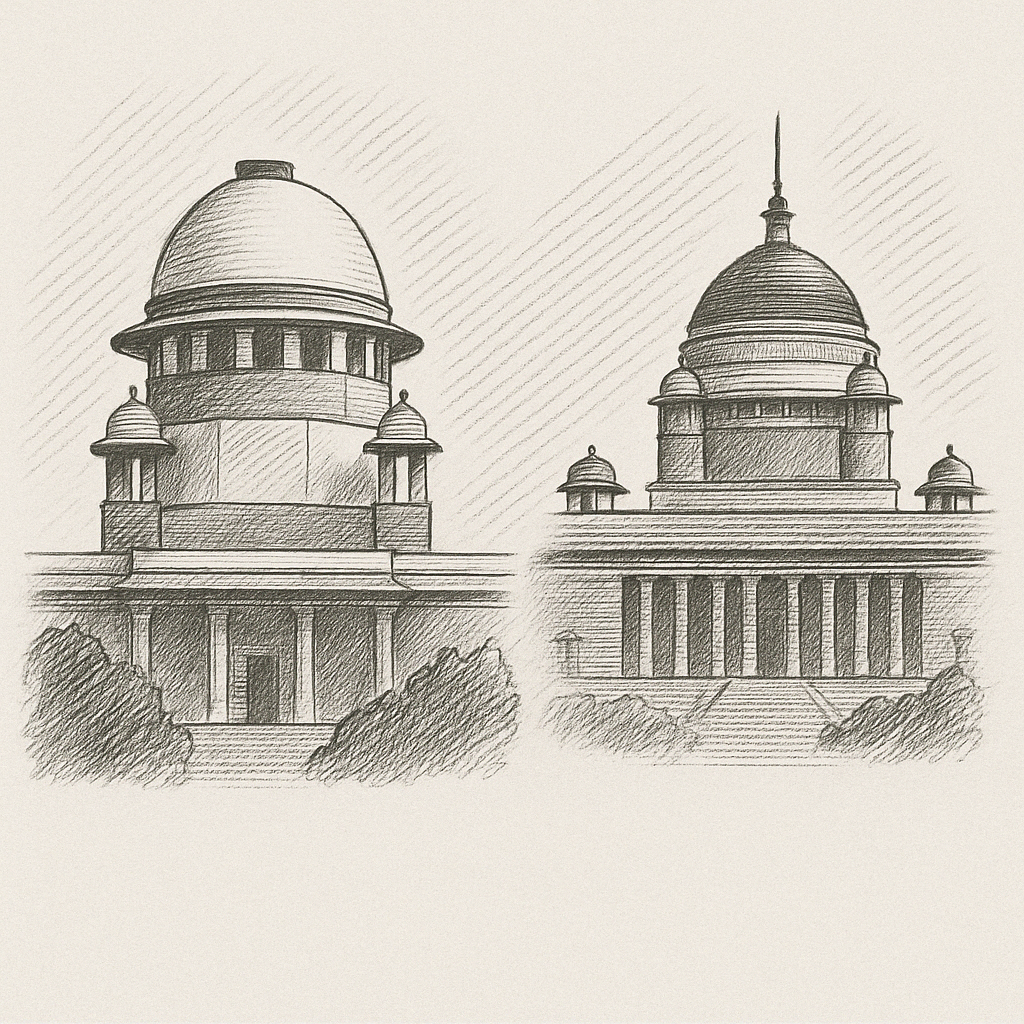
Once upon a quiet morning in Delhi – just yesterday – a constitutional clock began ticking—not on the walls of North Block, not in the Parliament’s echoing halls—but from the Courtroom Number One of the Supreme Court of India. The justices weren’t merely interpreting law that day; they were asking a question that shook the silence of Raisina Hill:

“Can the President of India keep a Bill waiting forever?”

That one question has now turned into a national debate—on federalism, legislative sanctity, and what critics call judicial overreach. But is it really overreach, or is it just the judiciary doing what it must when others don’t?

The Trigger: A Delayed Assent and a Waiting State

At the heart of it lies a chain of bills—some from non-BJP-ruled states—that were passed by state legislatures, sent to governors, and from there, made their way into the silent corridors of Rashtrapati Bhavan, only to sit without response. One of them was a Tamil Nadu bill on NEET exemption, others followed from Telangana, Kerala, and Punjab.

Months passed. Even years. No assent. No rejection. Just silence.

In constitutional language, this isn’t just a delay. It’s a denial of democracy, where elected representatives are told, without being told, that their laws don’t matter.

Enter the Supreme Court: A Gentle Reminder with a Firm Hand

In April 2025, the Supreme Court took a firm stance. It directed that the President of India must act on bills referred to her within a “reasonable time”—not exceeding three months.

It was not a command to pass a bill. It was not a push to reject it either. It was merely a constitutional alarm clock—saying “You must act. Democracy cannot wait indefinitely.”

The Backlash: Overreach or Oversight?

Vice President Jagdeep Dhankhar soon issued a sharp response. “The judiciary is turning into a super-parliament,” he warned. “Can courts now direct the President of India?”

This criticism echoes a concern many have raised in recent years: Is the judiciary crossing lines? Is it stepping into the shoes of the executive or legislature?

But Here’s the Counterpoint: Constitutional Silence Must Be Filled, Not Exploited

Let us be clear. The Supreme Court did not issue this direction under whim. It exercised its jurisdiction under Article 142—to do complete justice. And what could be more just than ensuring a legislative process reaches its logical end?

The Constitution never imagined that a Governor or the President could sit on a bill indefinitely. Our founding fathers didn’t envision executive silence as a political tool. And when constitutional gaps are weaponized into paralysis, judicial intervention is not overreach—it is oversight.

The Real Issue: Constitutional Morality and Federal Fairness

This case isn’t just about timelines. It’s about:

  • Federalism: When State Governments are unable to enforce laws passed by their legislatures, what message does it send about India’s unity in diversity?
  • Legislative Respect: Laws passed by elected assemblies deserve an answer—yes, no, or return with objections—not eternal limbo.
  • Institutional Responsibility: The President, bound by the advice of the Union Cabinet under Article 74, cannot be made a political shield.

What About Separation of Powers?

The separation of powers doctrine, often quoted in such debates, does not mean isolation. It means each organ must act within its role, and when one fails, another must intervene to preserve constitutional balance.

Think of it like a relay race. If the runner holding the baton stops mid-track, someone must nudge him—not to take the baton, but to remind him to keep moving.

In Closing: The Constitution is Not a Museum

It’s a living document. And sometimes, when the pens of legislators are paused and the signatures of executives are stalled, it is the gavel of the judiciary that must gently knock on the gates of democracy.

“Silence in governance is not neutrality. It is a choice. And when that silence stifles democracy, the courts are not only allowed—but obliged—to act.”

So no, this was not judicial overreach. It was constitutional stewardship. And the bell that rang from the Supreme Court was not a rebellion—it was a reminder that time, law, and democracy must all keep moving forward.

A Comparative Analysis: Section 156 of CrPC, 1973, and Section 175 of BNSS, 2023

In the evolving landscape of Indian legal procedures, the introduction of the Bharatiya Nagarik Suraksha Sanhita (BNSS), 2023, marks a significant milestone. This new legislation brings forth modernized practices aimed at enhancing the efficiency and accountability of the criminal justice system. A critical comparison between Section 156 of the Code of Criminal Procedure (CrPC), 1973, and Section 175 of BNSS, 2023, sheds light on the progressive changes introduced by the latter.

Section 156 of CrPC, 1973: Empowering the Police

Provision Overview:

  • Subsection (1): Empowers any officer in charge of a police station to investigate any cognizable case without needing prior approval from a Magistrate.
  • Subsection (2): Allows police officers to investigate offenses even if they were committed outside their territorial jurisdiction.
  • Subsection (3): Enables a Magistrate to order an investigation into any case, ensuring oversight in instances where the police may not act.

Key Takeaways:

  • Scope and Authority: Section 156 grants wide-ranging powers to police officers, facilitating prompt action in cognizable cases without the need for immediate judicial oversight.
  • Jurisdictional Flexibility: Officers can investigate offenses outside their jurisdiction, ensuring that legal boundaries do not hinder the pursuit of justice.
  • Magistrate’s Oversight: The provision for Magistrate-directed investigations acts as a safeguard against police inaction, allowing citizens to seek judicial intervention.

Section 175 of BNSS, 2023: Modernizing Investigations

Provision Overview:

  • Digitalization and Modernization: Advocates for the use of digital tools and modern investigative techniques to improve efficiency and accuracy.
  • Stricter Timelines: Introduces deadlines for completing investigations to ensure timely justice.
  • Enhanced Accountability: Implements stronger oversight mechanisms to reduce instances of police misconduct or negligence.

Key Takeaways:

  • Technological Integration: By incorporating digital tools, BNSS aims to streamline investigations, ensuring better evidence preservation and quicker case resolutions.
  • Timelines: Stricter timelines prevent unnecessary delays, promoting a more efficient justice system. However, it is essential to monitor the practicality of these deadlines to avoid rushed or incomplete investigations.
  • Accountability: Enhanced oversight mechanisms, such as regular audits and penalties for non-compliance, aim to ensure that police officers adhere to ethical standards and procedural requirements.

Comparative Analysis

  1. Empowerment vs. Oversight:
  • CrPC Section 156: Primarily focuses on empowering police officers with broad investigative powers.
  • BNSS Section 175: Balances empowerment with enhanced oversight and accountability, preventing misuse of power and ensuring thorough investigations.
  1. Technological Integration:
  • CrPC Section 156: Traditional in its approach, with less emphasis on modern tools.
  • BNSS Section 175: Embraces digital tools and modern techniques, representing a progressive shift towards a more efficient investigation process.
  1. Timelines and Efficiency:
  • CrPC Section 156: Does not specify strict timelines for investigations.
  • BNSS Section 175: Enforces strict timelines to expedite investigations, though the implementation and adherence to these timelines need careful assessment.
  1. Jurisdictional Flexibility:
  • Both sections offer flexibility in jurisdiction, but BNSS includes more structured procedures to maintain uniformity.

Conclusion

Section 156 of CrPC has been a cornerstone in empowering police officers to investigate cognizable offenses swiftly. However, its lack of emphasis on modern investigative tools and accountability has occasionally led to inefficiencies and misuse of power.

On the other hand, Section 175 of BNSS addresses these gaps by integrating digital tools, imposing stricter timelines, and enhancing oversight mechanisms. These changes aim to make the investigation process more efficient, transparent, and accountable.

The success of BNSS in revolutionizing the investigative process will hinge on its effective implementation and the ability to navigate the practical challenges that may arise.

Adv. Jayendra Dubey

advdubeyjayendra@gmail.com